Design ·
Naming our agent, and giving it a face
By Celeste Tsai

How a team vote gave sherpa's agent its name, and why the mark took three rounds and a step back.
Until October, the agent inside sherpa didn't have a name. In standups we called it "the agent". In the product it was "Ask sherpa". In docs it was "the sherpa agent". That works when you're describing a feature. It doesn't work when you're talking to something, and talking to it is most of what people do with it.
So in October we decided to name it. This week it got a face too. This post covers both: how we picked the name, and how the mark went from a dozen directions to one loop.
Everyone builds it, so everyone names it
The rule came up in a Dev Daily on 6 October. The whole team works on the agent, so the whole team should name it. Nobody gets to just decide. Everyone brought three names, and each one had to work for enterprise customers.
At sprint planning each person presented their shortlist, with a short story behind each name. A few of the others:
- Sirdar, after the person who runs an expedition: hires the porters, picks the route, deals with the officials.
- Shan, the Ladakhi word for the snow leopard, which works unseen and misses nothing. In Chinese, shān means mountain. As the Ladakhi saying goes, you never see the shan, but the shan always sees you.
- Senge, Tibetan for lion. The "lion's roar" means stating the truth so plainly that doubt disappears.
Then we voted.
On 28 October the name was Kora.
A kora is a circuit you walk around a mountain. Pilgrims don't climb it. They go round it, again and again.
That picture fit better than anything else on the list, because an agent works in a loop too. You ask, it acts, it checks, and it goes round again until the work is done. It doesn't do the hard part for you and disappear. It keeps the work moving with you.
A character, not a new brand
The first design question wasn't the logo. It was how much of a thing Kora should be.
We didn't want two brands. Most of the people using sherpa are still getting to know sherpa, so a second identity would just confuse them. My take from day one: Kora isn't a brand. It's the agent inside sherpa, and it deserves its own visual within the sherpa system.
So Kora uses our type and colours, and adds very little on top:
- One accent colour. We call it Korange. In the product, orange always means Kora. If something is orange, the agent is involved.
- One mark. Kora's avatar in the app.
- A few motion states, so you can tell whether Kora is talking to you or working in the background.
The goal was to make the agent's presence stand out without breaking sherpa's tone. Early tries taught us where the edges were. A big orange panel felt in your face. A thin orange line blended into the white background. What we ended up with is a small solid label and a frosted card for Kora's writing, with solid orange only at label size.
The mark, round by round
This is the honest middle part.
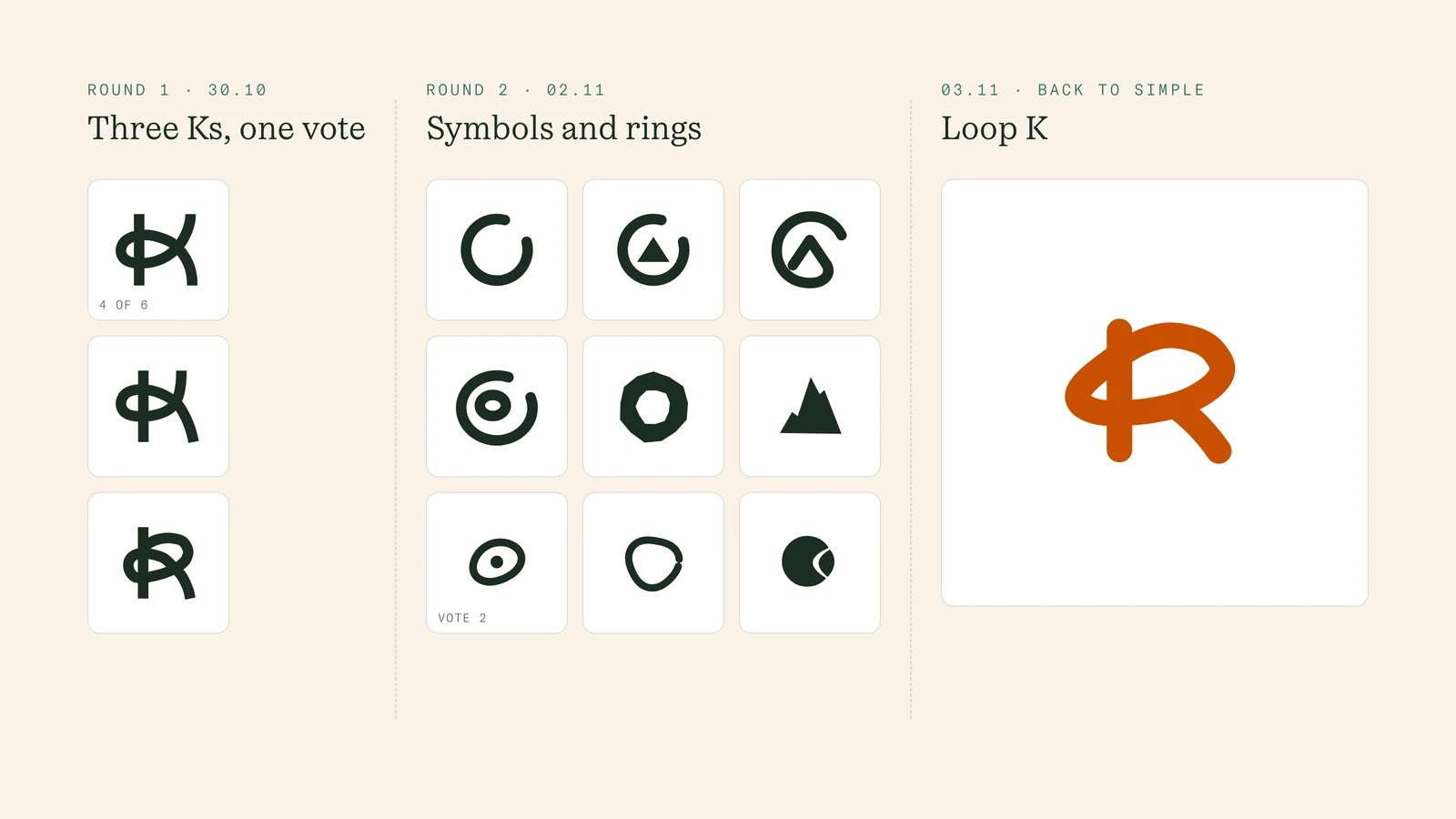
Round 1: three Ks. We started with the letter. A modified K, a K with an almond-shaped loop, and a K tied as a knot. Each one came with replying and working animations, and we put all three on one page for the team to vote. The modified K won, 4 votes of 6.
It won the vote, but it didn't quite win us over. It felt too complicated for something that small.
Round 2: symbols. Looking at other AI products, the marks that work are each a symbol of one thing. So we stepped away from the letter: a circuit, a peak inside a loop, one continuous line, contour lines, hand-cut shapes, a ring around a dot. Ring and dot went to a second vote against the round-1 K.
The team turned it down. And looking back, they were right. Most of round 2 was still variations on the same few ideas.
On the side: an image agent. While we drew, we also gave the brief to an image-generation agent in the browser and let it go wide: rings, pebbles, knots, orbits, a lot of wordmarks. It was a useful way to see a hundred options in an afternoon, and to find out which ones we didn't want. None of it ships. Every mark we use is drawn by us.
Round 3: back to simple. On 3 November we stopped making variations and went back to the one reference that had felt right from the start: a constructed K, made of a stem and a loop. We drew it twice, once clean and once by hand. The hand-drawn one was the one we liked, and we didn't need another vote.
Loop K

Loop K is three strokes:
- A straight stem. The work, standing still.
- A hand-drawn loop around it. Kora going round the work with you: ask, act, check, again.
- A leg stepping out. The moment the work is done and Kora hands it back.
It's one line weight and one colour, with round ends. It's hand-drawn on purpose, because we wanted it to feel made by people, not generated.
Underneath, it's the name drawn as a picture. The loop goes around the upright and never up it. That's the kora.
The whole name is in there too. Open the loop at the top and it's a K. Take away the stem and the leg and it's an O. The full mark reads as an R. Keep the bottom of the loop as a crossbar and swing the leg up, and it's an A. Same three strokes, four letters.
It moves
An agent spends a lot of time doing things you can't see. So the mark's motion tells you which kind of thing it's doing.


- Replying: the loop draws itself round the stem, then the leg steps out.
- Working: a gap walks round the loop, a lap at a time. You'll see this while Kora creates a document or sets up an engagement.
And from a team call last week, one more: when Kora doesn't understand something, or notices that you said one thing and then another (one cost centre, then a different one), the loop unwinds into a question mark. It tilts its head, then turns back into the K. A real agent should be able to say "I didn't get that", and now it can, without a word.

What's next
You'll see Kora wherever the agent works with you in sherpa: in the chat, in its replies, and while it does work for you in the background.
The part we'd keep from all this has little to do with logos. Voting is good at narrowing, and bad at picking. Every round we ran a vote on, we learned what we didn't want. The mark that stuck came from stepping back and asking what the name already meant.
An agent goes round the work with you. So does its mark.
Share this post
Share on LinkedInBuild the future of work with us.
Whether you want early access or you’re curious about joining the team, we’d love to hear from you.